The Smoke Point Myth
Most of what you have been told about cooking oil and smoke is half-right. Here is what actually matters — and why it has been overstated.
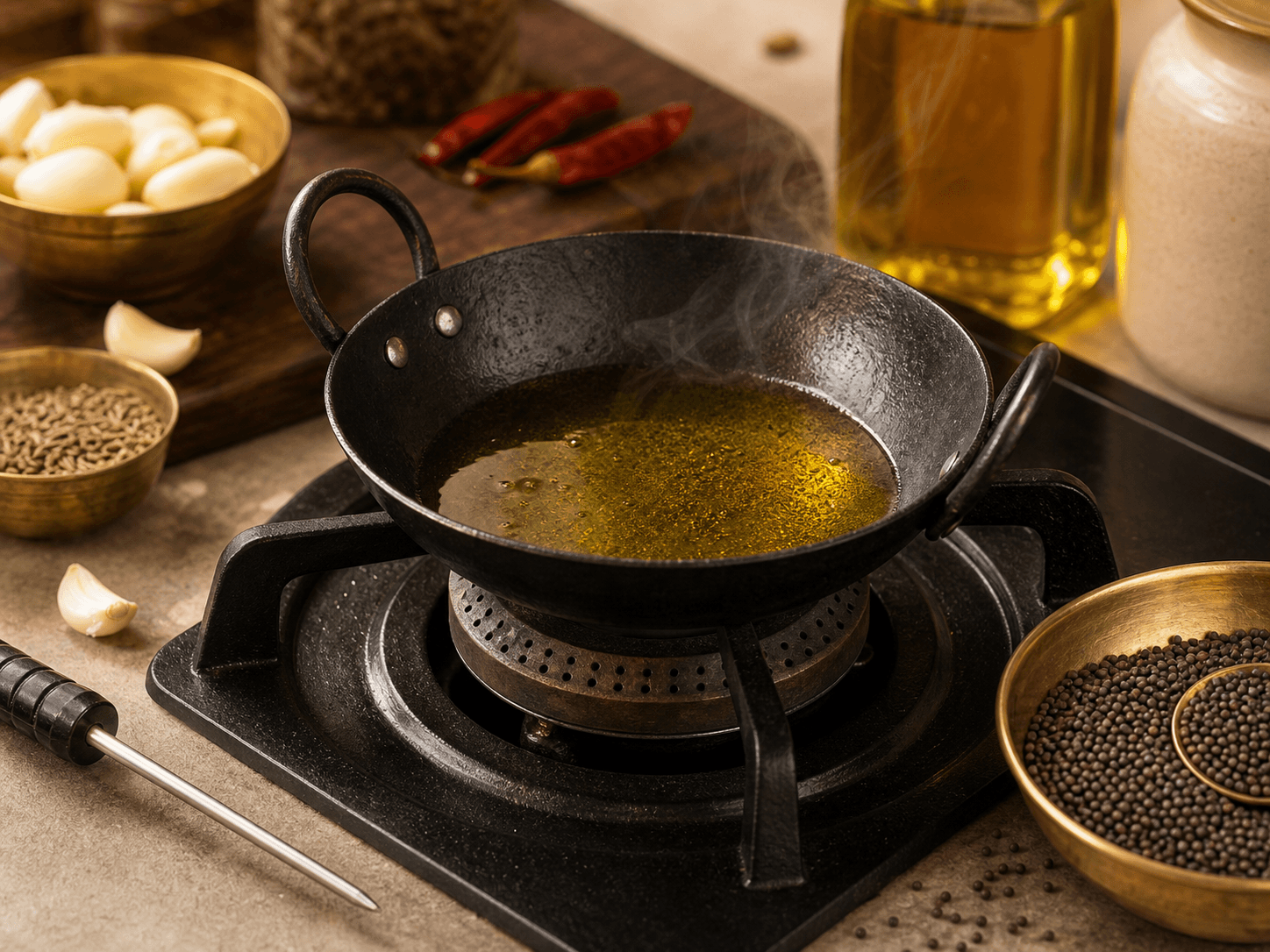
Every cooking oil has a smoke point — the temperature at which it begins to break down and release acrid compounds. The internet treats this number like gospel. Below the smoke point, safe. Above it, dangerous. The truth is messier and far less interesting.
What actually changes when oil smokes
When an oil crosses its smoke point, free fatty acids volatilise, glycerol degrades into acrolein (which is what makes your eyes water), and the oil's flavour begins to flatten. Crucially, none of this happens at a single hard threshold. It happens on a slope. A few degrees over, you are fine. Forty degrees over, repeatedly, for hours, you have a problem.
Indian cooking — the high-heat tadka, the kadhai-fry, the brief sear of mustard oil before fish goes in — operates in a deliberately narrow band, usually right at or just above the smoke point, for under thirty seconds. The cook turns the heat down the moment the colour shifts. This is not reckless. It is the technique.
What to actually pay attention to
- 1Use cold-pressed oils for low-to-medium heat finishing.
- 2Use the same oils for high-heat tempering — just briefly, and turn the heat down.
- 3Do not reuse the same oil more than twice. Repeated heating, not single use, is the real concern.
- 4Buy in smaller bottles, more often. Oxidation, not smoke, is what stales an oil.
The smoke point is a useful number. It is not the only number. And it is not a reason to switch away from the oil your grandmother trusted.