What a Litre of Honest Mustard Oil Actually Costs
A reader asked why a serious bottle costs more than the offer bin. Fair question. Here is the arithmetic of seed, handling, testing and how a too-cheap litre becomes possible.
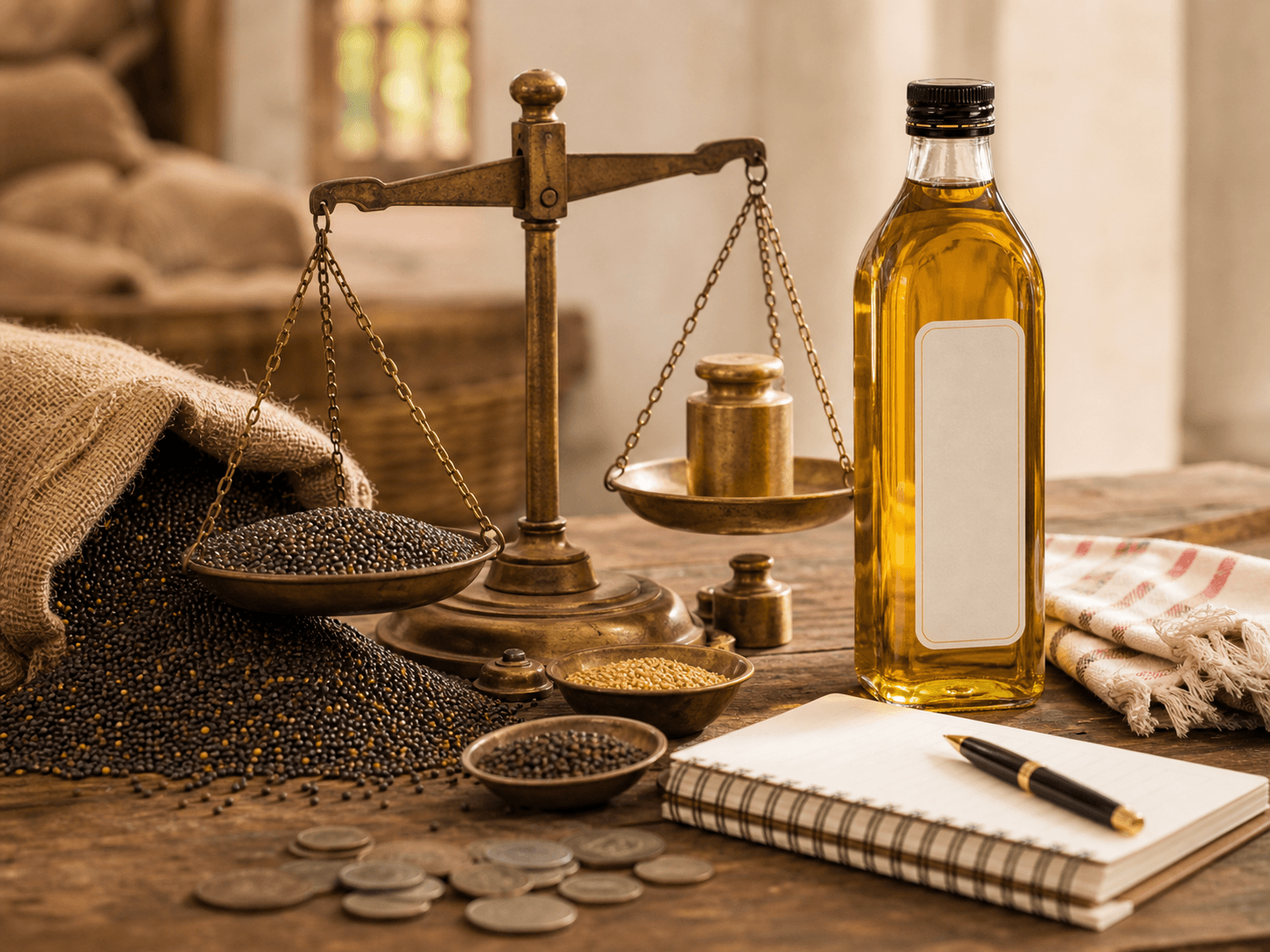
Last month a reader wrote with a photograph of a shop shelf: two bottles of mustard oil, side by side, both promising purity at very different prices. The letter asked a fair question: if two labels sound similar, why does one cost so much less? The honest answer is arithmetic, so let us do it in the open.
The arithmetic of a genuine litre
Good brown sarson carries roughly forty per cent oil, and a slow press does not recover every drop of it. In practice, a litre of genuine kachi ghani oil asks for somewhere between two and a half and three kilos of quality seed. Multiply that by what the mandi actually charged for bold, dry, clean seed last winter, and the seed alone accounts for the largest share of the bottle's price — before a single machine turns.
- 1Seed: the biggest cost in the bottle, and the first place a shortcut hides.
- 2Careful extraction and handling: slower, character-led oil costs more than anonymous commodity oil.
- 3Resting and filtration: clarity, stability and small handling losses all have a cost.
- 4Quality checks: peroxide value, free fatty acids, sensory review and fortification checks where applicable.
- 5Then everything ordinary: the bottle, the carton, freight, taxes, and the margins of everyone who moves it.
How a too-cheap litre becomes possible
When the selling price falls below the honest cost of the seed itself, the maths does not bend — something else does. The usual suspects: blending with cheaper oils, using old or damp seed bought at a discount, skipping checks, or quietly shaving the fill. Not every inexpensive bottle cheats. But below a certain floor, the question stops being rude and starts being arithmetic.
“Price is what the label announces. Cost is what the seed insists on.”
A fair test for any brand
Compare seed maths, not slogans. Ask what good seed costs, what careful handling costs, and whether the price on the shelf could survive those two numbers. Discounts and festival offers are normal trade; a permanent impossible price is not a bargain, it is a disclosure. A serious brand should be willing to explain its price line by line.