
How to Test Mustard Oil at Home: Five Checks Before You Cook
Adulteration is the first fear of every mustard oil buyer. Five simple checks you can run in your own kitchen — no lab, no equipment, just a fridge, your palm and your nose.
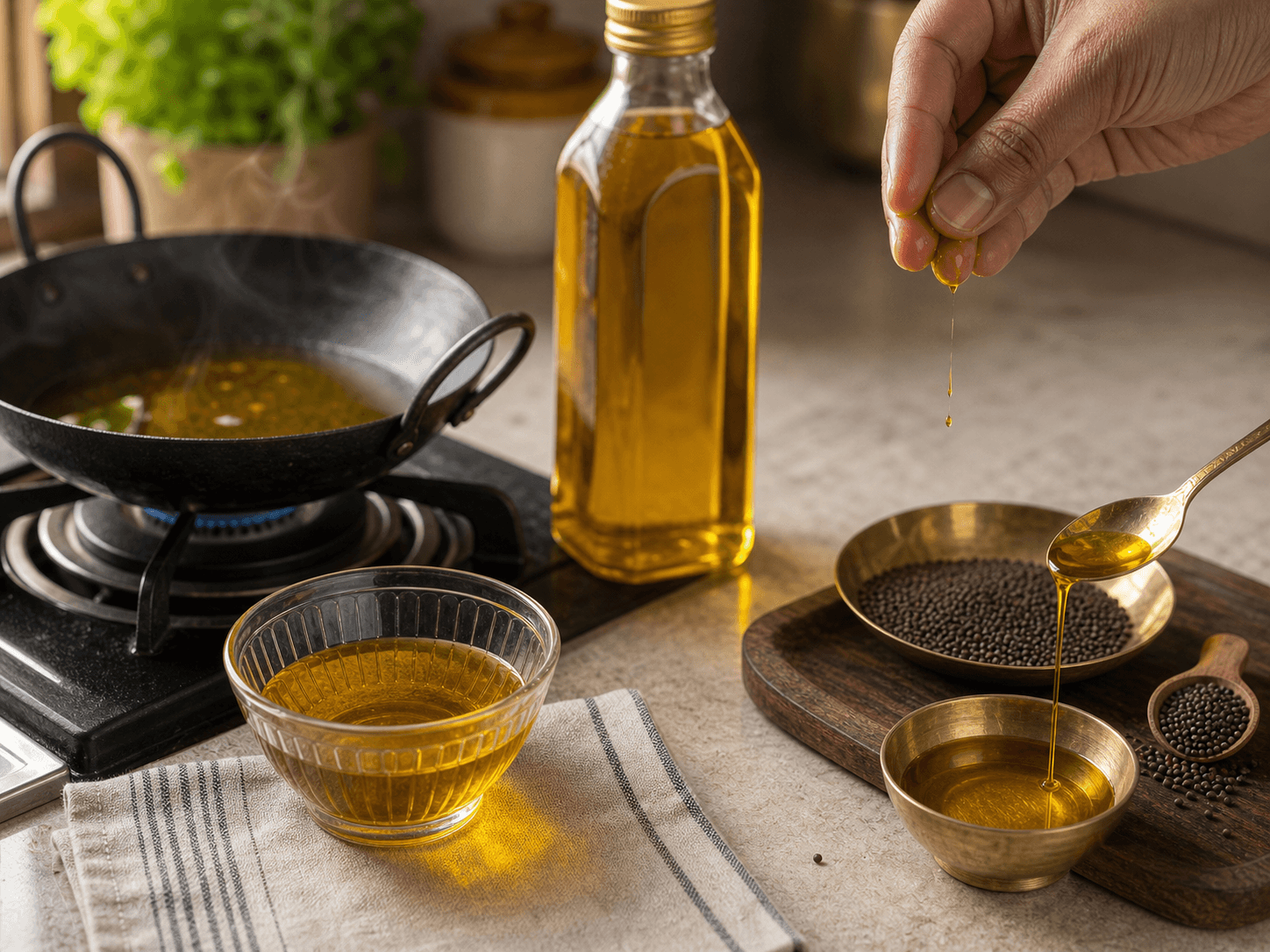
Industrial quality rooms can run peroxide value, free fatty acids, moisture, colour and sensory checks. Your kitchen has none of that machinery — and yet it has the three oldest instruments in quality control: cold, skin and nose. Used carefully, they will tell you most of what you need to know about the bottle on your shelf.
Check one: the fridge test
Pour a small katori of oil and leave it in the refrigerator overnight. Pure mustard oil holds its nerve in the cold — it may turn slightly cloudy, but it stays fluid and even. Many common adulterants, especially cheaper palm-based oils, begin to solidify into a whitish layer at fridge temperatures. If you find white sediment or a waxy crust in the morning, treat the bottle with suspicion.
Check two: the palm rub
Take a few drops in your palm and rub briskly until the skin warms. Now smell. Real kachi ghani leaves a clean, sharp mustard note that opens the sinuses and fades honestly. A chemical whiff — anything that reminds you of kerosene, paint or perfume — is a red flag. So is any colour left behind on the skin. Oil should not dye you.
Check three: watch the dhaar
The elders judged oil by its pour, and they were not wrong. Tilt a spoonful back into the katori and watch the stream. Good mustard oil runs a deep golden amber, dense and unhurried, in one even ribbon. An oil that pours pale, thin and watery has usually been cut with something lighter. The proverb exists for a reason: watch the oil, and watch the way it pours.
Check four: the nose knows
Warm one spoon of oil in a pan until the first wisp rises. The pungency that lifts off — the prickle of allyl isothiocyanate — is the signature of genuine cold-pressed mustard. It cannot be faked cheaply, and its absence is loud. An oil that heats up smelling of nothing has either been refined into silence or diluted into it.
Check five: read the seal, then the label
Before any kitchen test, the packaging has already spoken. An intact, tamper-evident seal. A food licence number. A batch code, a packing date that is recent, the AGMARK mark, the net quantity. A brand that prints its paper trail is inviting you to check it. Loose oil from an unmarked drum offers you none of these courtesies — whatever it saves you at the counter, it charges you in doubt.
“A lab can only measure what your nose already suspects.”
The five checks, on one card
- 1Fridge, overnight: pure oil stays fluid; white waxy layers are a warning.
- 2Palm rub: clean sharp mustard smell, no chemical note, no colour left on skin.
- 3The pour: deep golden amber, one dense even ribbon.
- 4The pan: real pungency rises with the first wisp of heat.
- 5The pack: intact seal, licence number, batch code, recent date, AGMARK.
One honest caveat from the lab bench: home tests are indicators, not verdicts. They catch the crude tricks, not the clever ones. The strongest protection remains buying a sealed, recently packed bottle from a brand that prints clear details and stands behind them. The kitchen checks are your second lock.