
The Kirana Ledger: Forty Years Behind One Counter in Sadar Bazar
Om Prakash has sold cooking oil from the same eight-foot counter since 1986. A conversation about drums, funnels, seals — and why trust is the only stock that never expires.
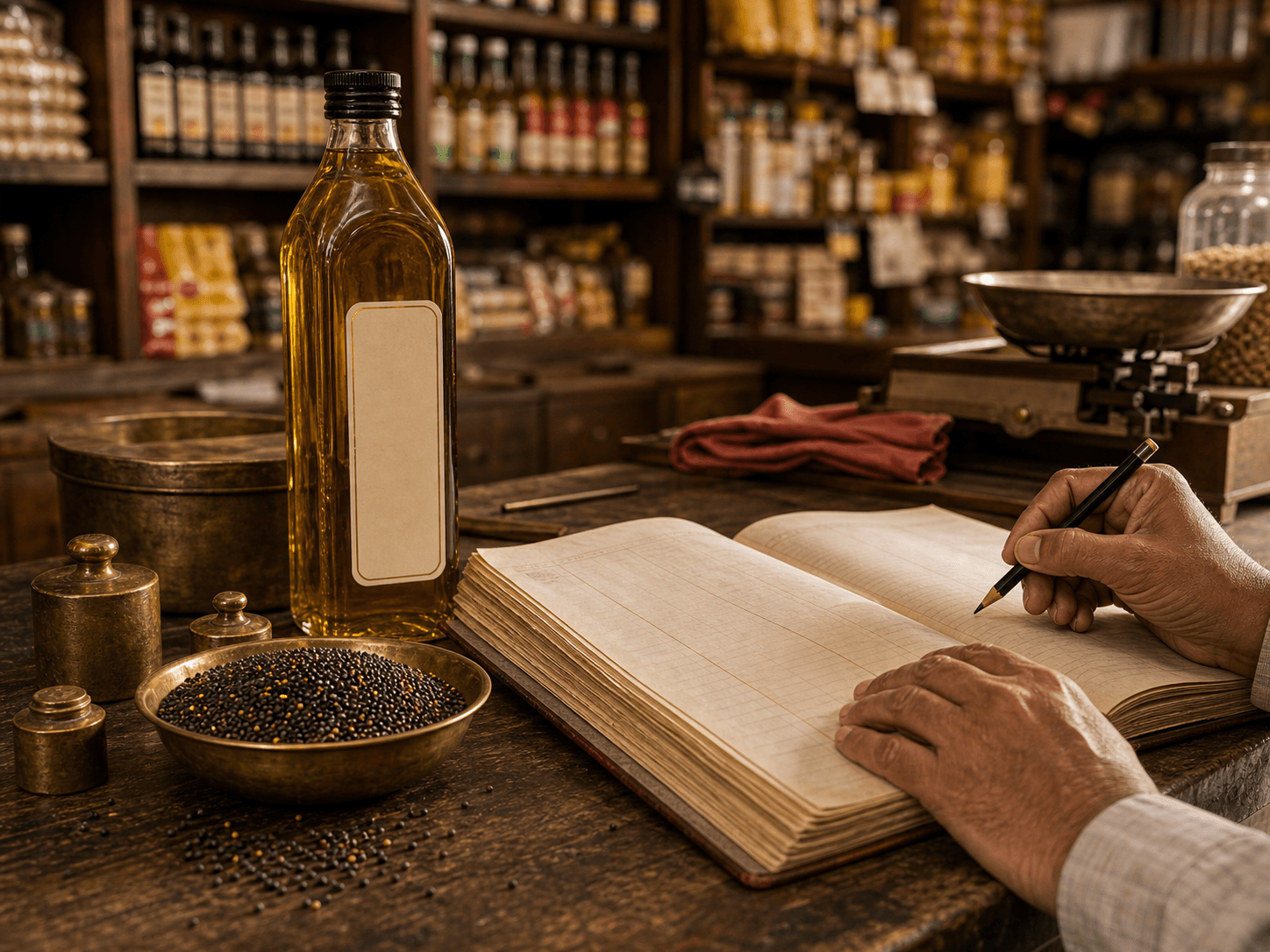
The shop is eight feet of counter in Sadar Bazar, Gurgaon, third generation, no name board that anyone reads. Behind the counter, on a shelf too high for customers to touch, sit the ledgers — cloth-bound, string-tied, one per year, going back past the point where the ink has browned. Om Prakash, sixty-three, took over the counter from his father in 1986. Oil, he says, is the first line of every household list, and the first thing a customer will change shops over.
“Earlier the customer brought their own bottle. Now the customer checks the seal. Both were tests. We just moved who gives the exam.”
The drum years
Until the early nineties, mustard oil came to the shop in fifteen-kilo tins and steel drums. The customer brought a bottle from home; he filled it through a tin funnel with a practised flick that ended the pour without a drop wasted. Arguments were about the last fifty millilitres and whether the measure had been struck level. Adulteration was an accusation you made against a man's face, not a factory. He remembers the responsibility as a weight: the shop was the last line of quality, and the shop had only a nose.
The seal changed everything
Pouches arrived first, then bottles. He was suspicious — packaging costs money and the customer pays for it. But he watched something shift. The argument at the counter ended. If the seal was intact, the promise had moved upstream, from his funnel to a factory's filling line and a printed batch number. The customer stopped testing him and started testing brands. His job changed from measuring to choosing: which brands deserved his shelf.
His test, still
He stocks nothing he has not smelled. From every new case of mustard oil, he opens one bottle, warms a spoonful over the little stove at the back of the shop, and puts his nose over it the way his father taught him. The bite should climb, then settle. Customers ask him which oil is properly kadwa — sharp the way the old oil was — and he answers from that spoon, not from the carton.
The khata
Fourteen families in the lanes behind the bazaar still buy on monthly khata, as their mothers-in-law did. The entries are in a shorthand only he can read: a date, a quantity, a rupee figure, sometimes just the word tel. Some of these accounts are older than his marriage. Nobody signs anything. The ledger is not really the record, he says. The ledger is a formality for the record kept somewhere else — in sixty years of turning up every morning and never once selling a bottle he wouldn't take home.
Retail, from behind this counter, is memory. The brands that last in his shop are the ones that understand they are being remembered.