
How to Store Mustard Oil — and Why Dadi's Steel Kuppi Worked
Oil rarely goes bad in the bottle you bought. It goes bad in the way you keep it. Light, air, heat — and the case for finishing small bottles fast.
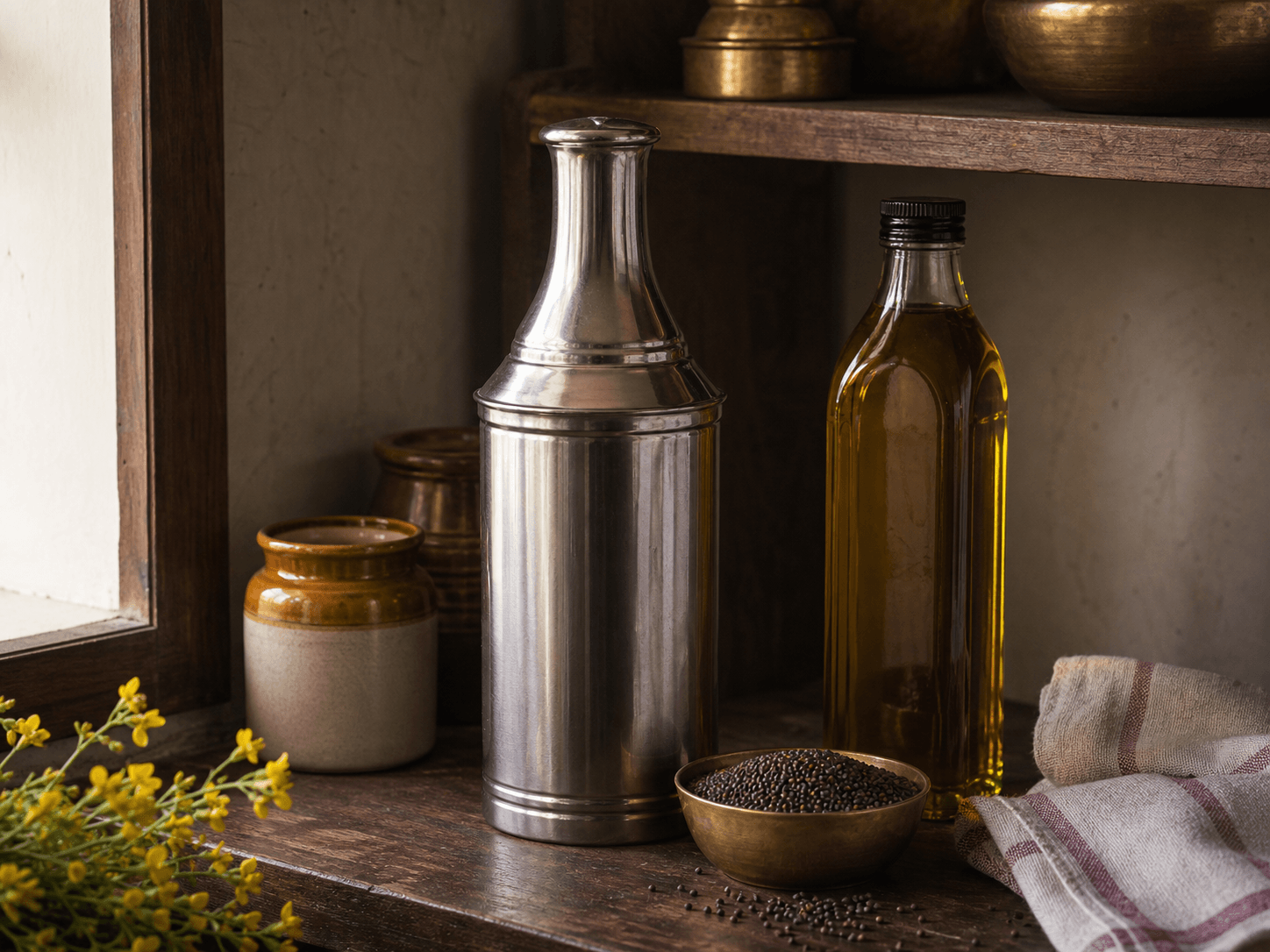
Here is a quiet truth of the kitchen: mustard oil almost never spoils in the sealed bottle. It spoils in the six weeks after you open it — on the shelf above the stove, in the dispenser left uncapped, in the big value pack that a small household could not finish before the season turned. Rancidity is not age. It is oxidation, and oxidation is a storage habit.
The three enemies
Light, air and heat — in that order of stealth. Light works on oil slowly and invisibly through a clear bottle on a bright shelf. Air gets in every time a cap is left loose, and keeps working between meals. Heat multiplies both: the shelf directly above the burner, the most convenient spot in the kitchen, is chemically the worst address an oil can have.
Why the old kuppi worked
Before branding, before bottles, homes kept oil in a steel or brass kuppi — opaque, narrow-necked, heavy-bottomed, stored low in the coolest corner of the larder. Look at that design brief with a chemist's eye: opaque walls block light, the narrow neck limits the air surface, the cool floor keeps the temperature steady. Nobody called it food science. It was simply what lasted. The grandmother was, as usual, the lab.
The modern rules
- 1Keep the mother bottle in a dark cupboard, away from the stove's heat shadow.
- 2Cap it tightly the moment you finish pouring — not after the tadka.
- 3Use a small steel or dark-glass dispenser at the stove, refilled weekly, so the main pack stays sealed and cool.
- 4Never pour used or leftover pan oil back into the fresh bottle.
- 5Buy the size you will finish in six to eight weeks. A fresh 1 litre beats a stale 5 litre every single time.
- 6Wipe the bottle threads occasionally — old oil trapped in the cap is where the stale smell starts.
Tin, plastic or glass?
Tins block light completely, which is why bulk kitchens and old wholesalers swear by them. Food-grade PET is perfectly serviceable if the bottle lives in the dark. Glass is the aristocrat — inert and honest — but heavy and unforgiving on a kitchen floor. The truth is that the vessel matters less than the discipline: a tightly capped plastic bottle in a dark cupboard outlives a glass one on a sunny sill.
And the retirement test: smell the oil before a big cook. Fresh mustard oil smells sharp and alive; oxidised oil smells like old peanuts, putty or paint. The old houses had a graceful ending for oil past its prime — it went into the evening diya. Light from the lamp, never back onto the plate.