
The Yellow Month: Basant Panchami and India's Mustard Spring
Every January the fields of the mustard belt turn the colour of turmeric, and the calendar answers with a festival dressed in yellow. Crop and culture, blooming together.
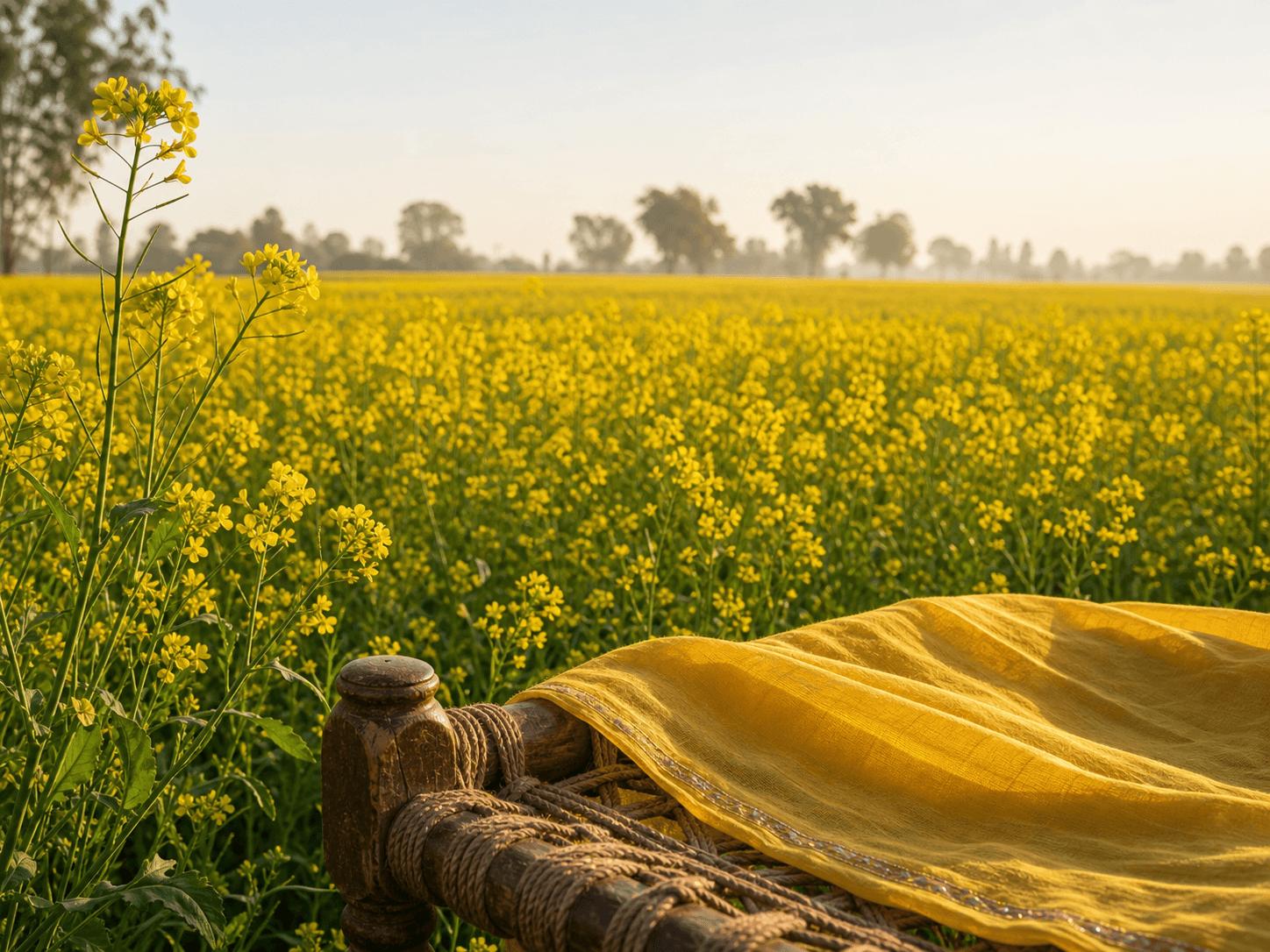
Take any train through north India in the last week of January and watch the window. Somewhere after the city thins, the land begins to signal: first one field of impossible yellow, then three, then an unbroken sheet of it running to the horizon, stitched with green bunds. The mustard is flowering. For six weeks, the plainest farmland in the country becomes its most photographed.
A festival the crop can keep
It is no coincidence that Basant Panchami falls in exactly these weeks. The festival that opens Indian spring is dressed head to toe in the crop's colour — yellow dupattas and turbans, marigolds on the books kept for Saraswati puja, saffron rice and boondi in the kitchen, kites climbing out of a hundred thousand terraces. Long before calendars were printed, the mustard bloom was the notification. The field set the dress code, and the festival has honoured it ever since.
The rabi clock
The timing is agricultural, not poetic. Mustard is a rabi crop: sown in October and November into the moisture the monsoon leaves behind, growing quietly through the fog weeks, and flowering when the light begins to lengthen in January. The flowers hold through early February, the pods fatten as spring warms, and by March the harvest begins. The bloom that fills camera rolls is, to the farmer, simply the crop's half-time announcement.
The field as an icon
Indian cinema and poetry long ago made the flowering sarson field a shorthand — for homecoming, for first love, for Punjab itself. No other crop in the country carries that kind of second job. The paddy field is landscape; the mustard field is emotion. It is a remarkable career for a plant whose actual assignment is to fill small dark seeds with oil.
What the farmer sees
Stand at the edge of a flowering field with the man who sowed it, and you learn the difference between a view and a crop. He is not looking at the yellow. He is looking through it — at pod set, at whether the cold snap forecast for next week will arrive during flowering, at the bees working the bloom. The flower is six weeks of beauty; the seed is a year of income. He will let you take the photograph, and then he will tell you what the photograph is worth if the frost comes.
So the next time a yellow field slides past your train window, read it the way the mustard belt does: as a promissory note. That colour is next winter's saag tadka, next summer's achaar jar, next year's first pungent wisp off a hot kadhai — being assembled, petal by petal, a season ahead of your kitchen.